⚡ 14 Days Inside The Live Trading Floor — Free, Full Access
Their Average Winner Ran 26 Days.
Their Average Loser Was Dead In 9.
Most traders do that exactly backwards — and it has nothing to do with picking the wrong stock.
For the next 14 days you can watch three full-time traders do it the right way. Live, on the mic, with their own capital on the line.
"I day trade to pay the bills... I swing trade to build wealth for my family." - JR Romero
Real Traders. Real Time. ◆ T3 Live, Trading Since 2007
You Heard A Ticker. Then What?
I’ve watched this happen to traders for fourteen years. It usually goes something like this...
Someone on CNBC likes it. A post on X says it’s about to break out. A guy at work swears by it...
So you buy some...
Maybe at the open... maybe whenever you got a free minute between meetings...
And then the hard part starts...
and you’re completely alone for it.
It drops four percent — is that noise... or is the trade broken?
It pops six — do you take it, or is that the start of the real move?
Earnings are Thursday and nobody mentioned it. Three weeks later you’re still holding, not because you have a reason, but because you never decided what the reason to leave would be.
That’s not a strategy problem. And it isn’t a discipline problem either.
Nobody ever showed you the order the decision is supposed to happen in.
I Never Buy A Stock Because I “Heard Good Things About It.” I Buy At One Price.
Here’s what nobody in this industry will tell you: the pros aren’t smarter than you. We just never make the decision in the order most people make it.
I don’t buy a stock because I heard about it. I build the case first — where the money is rotating this month, what the chart has been doing for eight weeks, the level where sellers finally run out. Then I name one price.
If the stock never comes to my price, I never buy it. Not a nickel higher. I just move on.
And before a single dollar goes in, I already know where I’m wrong, how much I’m willing to lose to find out, how big I start, and where my first trim comes off.
The entry is the last step. Not the first.
You can’t learn that from a stock pick. You learn it by watching somebody do it — over and over, out loud, with real money, while the market is open. That’s how I learned it. It took me years.
The Part Nobody Talks About With You... What Happens After You Buy... (It’s the most important piece)
I run a swing room at T3 Live called Sultans of Swing Trading with two other full-time traders, TDV and TG. We went back through every position the three of us took in 2026 — 197 of them — and measured something almost nobody bothers to measure. Not the win rate. How long we held.
83 percent of our losing trades were closed inside two weeks. And the eighteen positions that finished above twenty percent? We held those an average of 48 days.
Now think about the last stock you sold.
Almost everybody does this exactly backwards. They dump the winner in a week and nurse the loser for six months.
And that’s the single reason a text message can’t help you.
An alert hands you an entry. Fine — that’s the easy part, and it’s the part every service on earth is selling.
What an alert can’t do is sit with you in week three, when the thing has gone sideways for eleven sessions and every instinct you have is screaming to grab the six percent and be done with it. It can’t tell you the trend hasn’t broken. It can’t tell you it just did, today, and you should be out by the close. It can’t tell you to add into the pullback instead of panicking out of it.
For that you need people. Preferably three of us, with our own money in the same names, talking every day.
Four of these five happen after you’ve already bought
What I tell every new member
“It comes down to where you enter. Patience to wait for a trade to develop. Cutting losses fast. Adding to winners on their pullbacks, but also trimming winners into targets. And planning your watchlist ahead of time. If you do these things consistently, you will do well trading.”
Only one of those five is the entry. The rest play out over days and weeks — which is the whole reason I built this as a live room and not a mailing list.
There’s also one month buried in our 197-trade record that tells you more about us than any winner does. I’ll get to it — and it’s a month where we barely traded at all.
Listen To My Partner Turn Down Three Stocks In Ninety Seconds
Sultans of Swing Trading is a live Virtual Trading Floor — a room where the three of us work out loud while the market is open. Here’s a Monday morning, thirty minutes before the bell. TDV is on the mic:
Ninety seconds of a professional deciding not to buy
TDV, live in the room
“I love FSLR here. If SEDG didn’t have earnings coming up, I’d be all over this. I just can’t get into these things when it’s that dicey with the room.”
“I’m going to have a buy stop in NAVN at 272. And a buy stop in Oracle at 132.45.”
“CME is flirting with the buy stop at 270 and a half. I’m not going to take it yet. I’ll let you know if I get in it.”
“I am not chasing Oracle. The only place I’d chase is up to 133. I hate the chase. You guys know I hate the chase.”
Count what just happened. He named a stock he loves and refused to buy it because of an earnings report on a different company. He gave two exact prices where his own money goes in. He named a third, watched it flirt with his level, and still said no. Then he drew the line past which he won’t chase.
Four decisions. Zero of them were “here’s a hot stock.”
That’s what you’re getting access to. Not tickers — the reasoning that produces them.
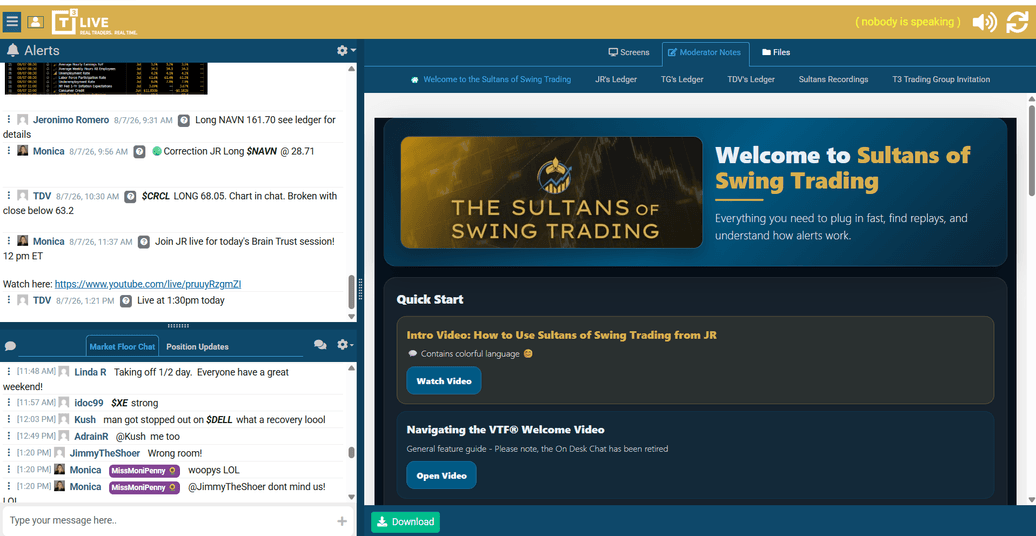
Why This Isn’t The Stock Newsletter Promising You The Next AI Retirement Play
Fair question, and it deserves a straight answer: they aren’t in the same category.
You know the format. An email lands promising the next AI retirement stock. There’s a ticker in it somewhere. There’s no price to buy at, no stop, no size, and no idea what to do if it drops twelve percent on Tuesday. Then it goes quiet. A random update shows up six weeks later, or doesn’t. You find out the trade is over by looking at your own account.
A typical stock newsletter
- ✗ One email. One ticker. “Buy now.”
- ✗ No entry price — you pay whatever it costs when you open the email
- ✗ No stop. No target. No position size.
- ✗ Silence after you buy
- ✗ Nobody to ask when it’s down twelve percent
- ✗ Losers quietly disappear from the record
- ✗ Often written by a marketer who has never had money in the trade
Sultans of Swing Trading
- ✓ A living portfolio you watch every single day
- ✓ Every idea comes with a trigger price — below it, we don’t buy
- ✓ Stop, target and sizing attached before you enter
- ✓ Trims, adds and exits alerted to your phone as they happen
- ✓ All three of us in the chat all day — ask us
- ✓ Losers announced on the mic, by name, same as the winners
- ✓ Nobody writes it. You hear it straight from us
A newsletter hands you a fish and walks away. This is standing next to three guys who fish for a living, watching us pick the spot, cast, and tell you when to reel in.
And you don’t have to quit your job to do it. That’s the point of swing trading. The thinking happens before the bell and after the close. The alerts find you during the day.
Get 14 Days Of Every Alert, Every Session And Every Ledger — Free
Full access from your very first session. A real person emails you before it ever renews.
Get My Free 14 Days Inside The Room ↓No charge today • Cancel by email, no phone call
We Open Our Books To You. Every Position, Every Working Order.
“Take a look at my ledger this morning.” You’ll hear me say that constantly, because the ledger is the heart of this thing.
Each of the three of us keeps a live ledger inside the room. Every position we’re holding. Every level we’re working. Every buy stop sitting in the market at this exact moment. It updates as we trade, and you’re looking at the same screen we are.
When I share mine, you’re looking at my seven-figure swing account. My own money — not a model portfolio, not a demo, not a spreadsheet somebody keeps for marketing.
So when I’m eyeing Eaton before the open, you don’t get a signal. You get my entire thought process:
Watch me size a trade I haven’t even placed yet
Me, live in the room, on ETN
“There’s a 99 percent chance I’m going to buy Eaton this morning. I just need to make sure it doesn’t sell off right away — so there’s no buy stop.”
“If you’re going to be conservative, your stop’s 359. I’m going to say 400. And I’m going to start with a quarter tier size here, because these are very wide stops.”
“When I have a tighter scenario for continuation, I’ll go four to eight times the tier size — once I know the probability of the trade working is much higher. These are big boy numbers. Size accordingly.”
Entry logic. Two different stops depending on your risk tolerance. A starter size of a quarter that only scales up after the trade proves itself. A target built off a measured move.
That’s a whole trade built in ninety seconds, on a random Tuesday. And it’s exactly the thing you can’t get in an email.
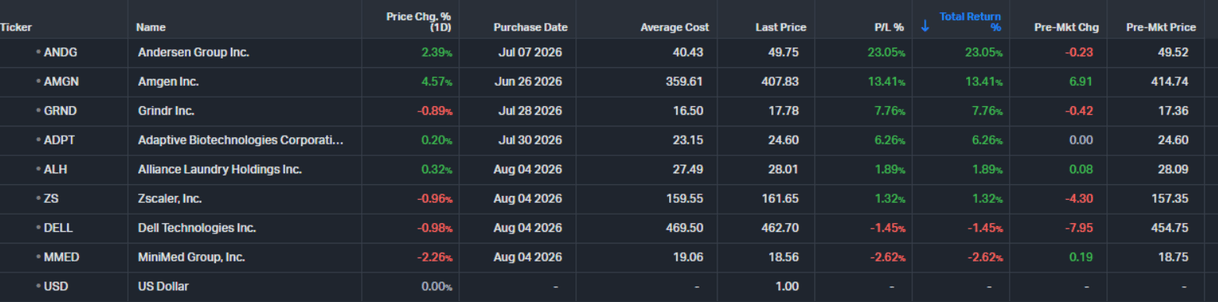
What The Three Of Us Do In The Hour Before The Bell
TDV, TG and I come into the room two to three times a day. Here’s what a real session actually contains — and why it takes an hour of our morning so it doesn’t have to take four of yours.
The 8:45 data drop that’s about to move your position
Not a headline dump. The releases flagged before they hit — “PMI at 8:45, ISM at 10” — then what changed overnight and what it’s doing to oil, the dollar and the ten-year. The morning the Houthis declared a shipping ban on Saudi Arabia, I opened the session walking through what that meant for energy names and for the risk-on trade. Before the open. Before anyone had to guess.
Whether today’s green screen is real, or about to roll over
There are mornings the S&P is green and the thing underneath it is rotting. TG will show you exactly where the Nasdaq sits against value, what volume is saying, and where the real line in the sand is. Then he’ll say the honest part out loud: “I don’t know if we get continuation next week. Nobody knows. I don’t care what anybody says. Nobody knows.”
Which sector is quietly getting all the money this week
Software strong, semis getting sold. Regional banks waking up. Nuclear, energy, cruise lines. This is the single most valuable thing in the session, because being in the right group beats being right about a company almost every time.
The earnings date that would have blown up your trade
This one saves accounts. Every name gets checked against the calendar before anyone touches it. “Datadog is the essence of sexy here. Problem is they’ve got earnings Thursday.” You’ll hear all three of us talk ourselves out of beautiful charts because of a report three days away — the exact landmine that has quietly wrecked more part-time traders than any crash.
Fifteen charts, and the one price that makes each one live
Never “this looks good.” TWST through 105.47, target 137. STX neckline at 93.75, swing to 114.50. WDC pinch at 583, stop under 502. AEHR through 100, room to 145 and 160. A level to get in, a level to get out, and the reasoning behind both.
And then all three of us open our own ledgers
Whatever we’re about to do with our own money that day, you watch us do it.
This Is What My Weekly Plan Looks Like
Not a list of tickers. A list of tickers with the exact price that turns each one live — and how I’d handle it. Straight off my screen:
INDV — buy point 43.38. “I like the way this one moves on the dance floor.”
Palo Alto — high tight flag on the weekly, 370.21. “I’m definitely going to be stalking this one, despite a very dodgy market.”
FA — 24.95, breakout off a multi-year base.
PAG — a short, under 58.50. Distribution top, room toward the 200-day if it breaks.
Liquidia — break of 82.86, looking for 103.19.
CCEP — wait for 111.21. “May need another week or two.”
Notice two things a newsletter would never show you.
We go short. When the tape says down, we take the other side. Most services can only ever tell you to buy.
And PAG wasn’t my idea. It came from Rafael — a member, in the chat. I looked at it, liked it, and put it on the official watchlist with a level attached. That happens in there all the time. The room is a conversation, not a broadcast.
You Don’t Have To Be At A Desk. Your Phone Will Find You.
This is the part people get wrong about trading rooms. You don’t have to live in it.
Every trade alert goes straight to your phone. Entry, target, stop — then the trim and exit alerts as the trade develops. You place the order in your broker and go back to your life.
The app pings you the moment one of us goes live, so you’re never sitting there waiting. Jump in from the car, the job site, the kitchen — wherever you are.
And every session is recorded. Listen to the whole thing on your phone on the commute, at the gym, or after the kids are down. Nothing is ever missed — only time-shifted.
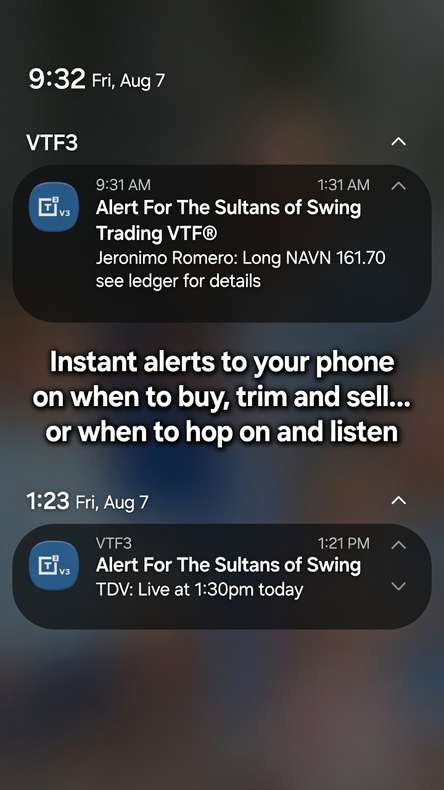
Put Three Professional Traders In Your Pocket For 14 Days
Every alert, every session, every recording. Nothing held back for paying members.
Get My Free 14 Days Inside The Room ↓No charge today • Real humans on hand the whole trial
Where We’re Actually Putting Our Money Right Now
147 different names in seven months. We’re not recycling the same ten tickers and calling it a service.
But run our whole book through a sector screen and one engine jumps out immediately:
| Where we traded | Share of book | Avg per position |
|---|---|---|
| Semis & semi equipment | 11% | +11.2% |
| Storage & data infrastructure | 18% | +6.3% |
| Industrials, infrastructure & defense | 19% | +5.8% |
| Energy, materials & metals | 17% | +3.7% |
| Healthcare & biotech | 15% | +2.6% |
| Consumer, retail & travel | 13% | +2.5% |
| Financials & fintech | 7% | +5.6% |
Semis, storage and data infrastructure were 29 percent of our book — and averaged roughly double everything else per position.
Six Of Our Biggest Winners Of 2026 Were All The Same Trade In Disguise
ACMR +102% — semiconductor manufacturing equipment
STX +73.9% — hard drives and mass storage
STRL +68.7% — the contractor that physically builds data centers
MRVL +50.1% — custom silicon
NVMI +32.4% — semiconductor inspection
POWL +27.5% — the electrical gear that powers all of it
These are the six largest results out of 197 positions and are not typical. The average winner in the same record was 11.6 percent, and 81 of the 197 positions lost money. Figures are the final marked value in the room’s position-update tables. Past performance does not guarantee future results.
Chips. The storage that feeds them. The power that runs them. The company pouring the concrete around them.
That’s the physical buildout of AI — and while everyone else was arguing about which mega cap to own, we were three layers down the supply chain, buying the companies that get paid either way.
The only three things I screen for
What I tell the room
“I’m looking at three important things: sector strength, sentiment, and technicals. This is a market that’s completely narrative driven. A lot of these fundamentals don’t make sense — but sentiment always makes sense, and sector strength always makes sense.”
We’re not one-trick, though. Healthcare was fifteen percent of the book. Energy and materials, seventeen. When money rotated into managed care we were in Molina and Oscar Health. When it went to industrials, Caterpillar and GE. We follow the rotation instead of marrying a thesis.
And one more thing worth knowing before you join: eighty-five percent of our positions weren’t household names. Not penny stocks — real, liquid mid caps like Sterling Infrastructure, Powell, Nova, Klarna, Pattern Group. The names nobody on TV is talking about. Those averaged nearly double what the mega caps did.
197 Trades Through An Up-And-Down Market. Including The Ones That Hurt.
The record below covers 197 positions marked between January and July 2026. Fifteen of them were opened in late 2025 and carried into the year; the rest were opened and marked inside it. That stretch was not a straight line — a leg up, a real gut-check through late February and March, then a recovery. Which is exactly the kind of market you want to judge a swing trader on, because anyone looks like a genius in a tape that only goes up.
We were right roughly six times out of ten — good, not miraculous. But our average winner ran three times bigger than our average loser. That gap is the whole business.
It doesn’t make us right more often. It makes us wrong smaller.
Only three of the 197 positions lost more than ten percent. Nearly three-quarters of our losing trades were cut for less than five. That’s what “respect your stop” looks like once you count it.
Our 14 Biggest Winners Of The Seven Months
| Ticker | Trader | Entry | Final mark | P/L |
|---|---|---|---|---|
| ACMR | TDV | Dec 1 | Feb 26 | +102.0% |
| STX | TG | Apr 14 | Jun 29 | +73.9% |
| STRL | JR | Apr 29 | Jun 29 | +68.7% |
| SOLS | JR | Dec 10 | Mar 3 | +62.8% |
| MRVL | TDV | Apr 30 | Jul 13 | +50.1% |
| NVMI | TG | Dec 30 | Mar 3 | +32.4% |
| PTRN | JR | Jun 18 | Jul 17 | +32.2% |
| CAT | JR | Apr 21 | Jun 30 | +28.8% |
| POWL | JR | Apr 8 | May 1 | +27.5% |
| CAKE | JR | Jun 8 | Jul 20 | +26.5% |
| BTU | JR | Dec 18 | Jan 26 | +23.8% |
| URGN | JR | Jun 17 | Jul 17 | +21.7% |
| KLAR | TDV | May 18 | Jul 17 | +21.3% |
| TER | JR | Apr 8 | Apr 27 | +20.6% |
41 of the 197 positions finished above 10 percent. 18 above 20 percent. 5 above 50 percent. Four of the positions listed above were opened in December 2025 and carried into the year.
Here Are All Eight Losses Worse Than Seven Percent
Not a sample. These are our eight ugliest results out of 197 positions — the entire downside of seven months, in order. Nothing outside this list was worse than minus seven percent. And yes, seven of the eight are mine.
| Ticker | Trader | Entry | Cut | P/L |
|---|---|---|---|---|
| FRMI | JR | Feb 25 | Mar 4 | −14.9% |
| JOBY | JR | May 26 | Jun 9 | −14.8% |
| PLAB | JR | Feb 25 | Mar 4 | −12.2% |
| GLNG | JR | May 5 | May 26 | −8.9% |
| DECK | JR | not recorded | Mar 4 | −8.2% |
| ALMS | JR | Feb 19 | Mar 18 | −7.5% |
| VELO | TDV | May 26 | Jun 3 | −7.4% |
| NKLR | JR | Jan 13 | Jan 20 | −7.1% |
DECK’s entry date wasn’t captured in the position feed. The exit was — so we left the trade in rather than quietly drop it.
Ask the last newsletter you subscribed to for that list and see what happens.
Figures are the final marked value of each position as shown in the room’s position-update tables — last marked, not a broker-confirmed fill. Past performance does not guarantee future results. Trading involves significant risk of loss.
March 2026: Five Trades In The Entire Month. That Was Your Money Being Protected.
Here are the new positions the three of us opened in 2026, month by month:
| JAN | FEB | MAR | APR | MAY | JUN | JUL |
| 24 | 20 | 5 | 45 | 33 | 37 | 17 |
181 new positions opened during 2026, plus 15 carried in from late 2025 and one with no recorded entry date — 197 in total.
Five new positions in an entire month.
That’s not a slow month. That’s a decision — and it’s the most expensive thing most services will never do for you, because a service that stops trading looks like a service you should cancel.
Here’s what I told the room on a Monday, with the Middle East escalating over the weekend:
The morning I told everyone to stop trading
Me, live in the room
“I sold 80 percent of my positions on Friday. My spidey senses were going off that we were going no place good, fast.”
“As for today — I have no trades in the hopper. I’m going to watch and see what the market does.”
“You need to take what the market gives you when the market gives it to you. And then you need to sit on your hands and wait. When you try to take something from the market that it’s not willing to give you, that’s usually when tragedy ensues.”
I Have A Name For The Thing That Quietly Drains A Trading Account
Put a frog in a pot and heat the water slowly and it never jumps out. The same thing happens to traders in a bad market, and I hammer on it until my members are sick of hearing it:
The warning I repeat until members roll their eyes
Me, on the boiling pot effect
“After a while you get used to market conditions being horrible, but you keep trading the market the way you always have. You become numb to it. You keep taking shots and nothing works. Beware of the boiling pot effect. Things are really difficult right now — and we have to keep reminding ourselves that they’re difficult.”
And the other half of it — the wishful thinking that shows up right when you’re most desperate for the market to turn:
Why you think the bottom is in (and why it usually isn’t)
Me, to the room
“When the market is really ripping, guys, trust me — we will all know. A lot of the time we look for any sign that the bottom is in, and that’s just self-confirming bias. Your desire to participate. When the market is running, you will know it immediately.”
Then I told them what to do with the waiting: “When the market is difficult, it’s a great time to invest our time in observation. What held up? What managed to rally despite headwinds? Those are going to be the next ideas that work when the market stabilizes.”
Which is exactly what happened. March: five trades. April: forty-five.
Preparation. Then patience. Then aggression. In that order — and never out of it.
How A Losing Trade Sounds When Nobody’s Trying To Hide It
Eighty-one of our 197 trades in that seven-month record lost money. Inside the room, a loser doesn’t quietly fall off a list — it gets announced on the mic, by ticker, exactly like the winners.
CCJ, stopped out at 84. TDV’s words to the room, live: “Little loser. They happen in every service.”
RBRK and Dell, both hit inside a week. Also TDV, out loud: “We tried RBRK last week. They got destroyed. Dell got destroyed. Some things that really look good got really messed up quickly.”
The reason our average loser sits under four percent is one rule all three of us repeat constantly: honor the stop, cut fast, never average down into a broken trade.
You’ll also watch me miss things. I stepped away from my desk, cancelled my own buy stop, and then watched that name run without me. I told the whole room about it afterward. “It hurts my soul.”
What restraint actually sounds like out loud
TG, on a tape he didn’t trust
“I am itchy to take some swings. But I am not itchy to get my face ripped off again.”
That’s the room. Not a highlight reel — a real desk, with real mistakes narrated in real time, which is the only place anybody has ever actually learned to trade.
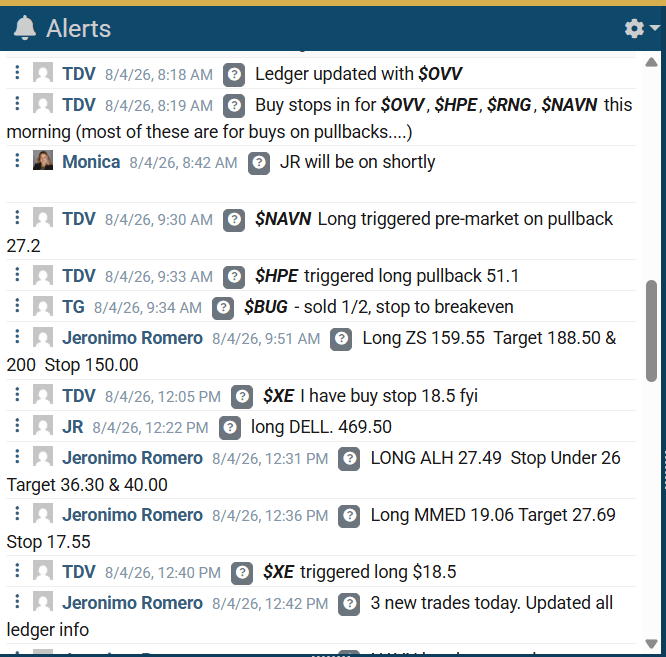
I Walked Out Of A Hedge Fund In The Middle Of A Crash

I came to this country at 19 and worked my way through college, selling spare telephone parts on the side for extra cash. I got a degree in history and computer science. I launched more than a dozen businesses. Most of them failed.
Then in 2009 — the middle of the Great Recession, with the market in ruins — I quit my job at one of the largest hedge funds in the world to trade my own money. Plenty of people told me that was reckless.
They had a point. I made every mistake there is to make, and it took years before I could trade with the discipline of a professional.
That was fourteen years ago. I still trade full time. I’m up around 5:30, reading news by 6, trading pre-market by 7, usually done with my goal for the day by 8, then preparing for the open at 9:30. I lead Momentum Express, one of the fastest-growing rooms at T3 Live. My son does my overnight scanning.
My method isn’t an indicator, and I’ll tell you that within four minutes of meeting you. It’s Wyckoff — reading where a stock sits in the accumulation-to-markup cycle, and buying the exact point where sellers run out and there just isn’t enough stock left to meet demand. Context first. Then structure. Then price action. Then the tape, as the final smell test.
“Forget the indicators. The ultimate indicator is price. Price tells you where the auction is, what supply and demand look like, and where things are most likely going.”
— JR Romero
I’m also the guy who opens a session by announcing that every time I say the market is at a key inflection point, the room has to drink. Nobody in there takes themselves too seriously. The trading is dead serious.
This Room Exists Because My Members Complained About Me For Years
Here’s the honest origin, and it isn’t flattering.
For years, the single biggest complaint I got from my own paying members was that I didn’t give enough real-time alerts.
The reason was simple. I run Momentum Express, a day trading room, and I’m scalping all day inside it. My swing trades — the ones I hold for weeks, the ones that actually build my account — were getting mentioned in passing while I was busy trading something else. Members would hear a great idea, blink, and it was gone.
People told me. Repeatedly. For a long time.
So I moved the swings out of the day trading room and built them their own home: alerts that push to your phone, a written game plan every week, and two other full-time traders alongside me so the coverage never depends on one guy’s schedule.
That’s the whole reason this exists. Not a marketing plan — a complaint, answered.
Which also explains the format. It isn’t built to impress you. It’s built so a swing idea never gets lost again.
What Happens To Your Alerts When The One Guru You Follow Gets Sick
Almost every alert service out there rests on one person. If that person gets sick, goes on vacation, or hits a bad month, you get silence — and you’re sitting on open positions with nobody to ask.
That’s not hypothetical. I got knocked out sick for over a week this year. The room never missed a single morning, because TDV was on the mic covering for me, walking the same positions with the same levels.
TDV — the macro guy
His pre-market briefing is the most thorough of the three of us. He’ll walk the overnight tape, rates, currencies and index structure before he ever shows you a stock — the morning the US intervened with Japan to buy yen, he explained to the room why yields and the dollar were behaving the way they were, before the open.
Then his ledger comes up with the exact buy stops he’s placing. He runs much of his own book through options and will walk you through strike selection and delta if you ask him in the chat. He’s the one who says “I’ll let you know if I get in it” — and then actually does.
He’s also the one who covered every session I missed.
TG — the sniper
The most selective of the three of us, and the deepest in volume profile — value areas, points of control, anchored levels. Fewer names, bigger swings. Two of the largest winners in our seven-month record came out of his ledger.
When he takes something riskier, he says it plainly: “This is not a full-size player. If you’re not comfortable with that, by all means pass on it.”
And when he doesn’t trust the tape, he goes to cash and tells the room exactly why — which is how he spent a good part of the summer, out loud, while it was happening.
Three styles, one room, one alert feed. On a thin week somebody in there is still finding something. And when none of us like the market, you hear that too — which, as March showed, is worth just as much.
One honest note: we’re three working traders with families and lives. We’re in the room two to three times a day as a rule, but a session gets missed here and there. When it does, we say so — and everything is recorded either way.
Sultans Of Swing Trading vs. My Momentum Express Day Trading Room
I run both. They’re completely different animals, and picking the wrong one is the fastest way to be disappointed.
Sultans of Swing Trading
- ✓ Swing trading — holds from one day to thirty
- ✓ 10+ trade alerts a week to get in and out
- ✓ Three traders sending real-time buy, trim and sell alerts
- ✓ Runs off my weekly watchlist — no watching thousands of tickers
- ✓ Never chasing whatever gapped up this morning
- ✓ Videos on open positions plus the weekly game plan session
- ✓ Built for people with a job who are still learning the method
Momentum Express Day Trading Room
- • Day trading and scalping — in and out inside the session
- • No trade alerts — you follow me live on the mic
- • Hours with me as I call out moves and pivot points
- • Tickers change daily — whatever momentum is moving
- • If a name is popping today, that’s what gets traded
- • Nightly wrap-ups and Sunday warm-ups
- • Built for experienced day traders who know order flow
If you have a job, a family, or anything at all happening between 9:30 and 4:00 — Sultans is the one that fits your life.
The Company Behind My Room Has Been Doing This Since 2007
Worth knowing who you’re handing a card to.
T3 Live has been in business since 2007 — through the financial crisis, the 2020 crash, the 2022 bear market and everything since. It was built by working traders, not marketers, and it’s still run by them.
Its affiliate, T3 Trading Group, LLC, is a registered SEC broker-dealer and a member of FINRA and SIPC. That’s not something a newsletter publisher can say about itself, and it’s a matter of public record you can check in about thirty seconds.
The Virtual Trading Floor you’ll be logging into is T3’s own technology, built in-house over years and running live rooms across stocks, options and futures — with a full roster of working traders behind them, several of whom you’ve seen on CNBC, Fox Business, Bloomberg and Schwab Network.
And behind all of it is a customer service team of actual people who answer email — which matters more than it should, and which you’ll see in a minute.
See All Of It For Two Weeks Before You Pay Anything
Every session, every ledger, every alert. Then decide.
Get My Free 14 Days Inside The Room ↓No charge today • A real person emails you before it renews
What My Members Say When Nobody’s Selling Them Anything
These aren’t collected testimonials. They’re messages people typed into our room chat on ordinary afternoons:
“Just want to say THANK YOU!!! to JR, TG and TDV. In just over a month, I have made my yearly subscription fee back and then some. Appreciate all the work they do, as well as their thoughts on the trade and setups and all the updates!”
— Tammy G
“Couple of good trades and I paid for the price of Sultans in 1 week.”
— Larry R
“I joined Sultans in Dec 2025 and couldn’t be happier, learning so much! Thanks Sultans crew and JR.”
— Joe
“TDV — I sold my YOU at 34! Thank you!”
— Nadia
“TDV — the AEO options paid for my annual subscription.”
— Larry R
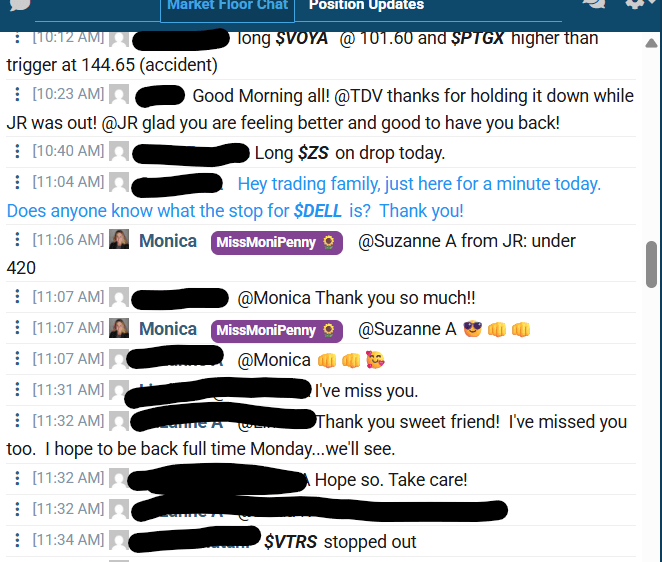
And this is what our chat sounds like on a normal afternoon — members bringing their own reads, not waiting to be told what to think:
“TDV, I am in AEO options, very small though. Look at DLTR today — better than expected earnings estimate, better forecast, yet sold off pre-market. Buyers and bottom fishers never showed up!”
— Zahoor
The testimonials shown are from individual subscribers and may not be representative of your experience. Individual results vary. Past performance does not guarantee future results.
Why Starting This Week Matters More Than Starting Next Month
Two reasons, and neither one is a countdown clock.
The first is the market you’d be walking into. Look back at that sector table. The gap between our best group and our worst was more than four to one. In a tape this narrow and this rotation-driven, being in the right sector is doing more of the work than stock picking is — and figuring out where the money is moving each week is exactly what the first twenty minutes of every session is for. A market like this is when a room earns its keep. A market where everything goes up is when nobody needs one.
The second is simple arithmetic. Your fourteen days start the moment you join. Come in now and the whole thing counts — my next weekly game plan, every session between here and there, every alert. Come in on a Thursday and you’ve spent two of your fourteen days on a weekend.
There’s no artificial deadline here and I’m not going to invent one. It just works better if you’re in before my next plan gets written.
Please Don’t Join If Any Of This Sounds Like You
I’d rather lose the sale than have you in the room for the wrong reason.
- You want intraday scalps. Wrong room entirely. That’s Momentum Express, and you’d be bored senseless in here waiting three weeks for a trade to work.
- You want a hot ticker and nothing else. There are cheaper places to get one. Most of the value in here is in the parts you’d skip.
- You won’t honor a stop. The only reason the average loss in our record is under four percent is that we get out when we said we would. If you move stops, none of this transfers to you.
- You need it to work in week one. Our average winner took 26 days. Two weeks is enough to judge the room. It isn’t enough to judge a swing strategy.
- You’re trading money you can’t afford to lose. Then don’t. Not here, not anywhere. 81 of our 197 trades lost money.
Still here? Then here’s exactly what you get, and exactly what it costs.
What You’re Getting For The Next 14 Days
In real numbers, across a two-week trial: roughly twenty live sessions, two full weekly game plans, on the order of twenty or more trade alerts across the three of us, hundreds of charts walked with levels attached, and a recording of every minute of it. Here’s how that breaks down.
| Live sessions with all three of us, two to three times a day Macro, index structure, sector rotation, earnings risk, and the full chart walk with entry and exit levels. |
Included |
| Real-time trade alerts pushed to your phone Entry, stop and target — then every trim, add and exit as the trade develops. 10+ a week. |
Included |
| All three live ledgers Every open position and every working buy stop from me, TDV and TG, updated as we trade. |
Included |
| My weekly game plan session The full watchlist built name by name with trigger prices, targets and stops. Most of the week’s ideas come out of this one session. |
Included |
| TDV and TG’s ideas and guidance all week Two more full-time traders posting setups, options ideas, and answering questions in the chat. |
Included |
| The full recording archive Every session recorded and playable on your phone. Miss it live, hear all of it on the commute. |
Included |
| The T3 Live mobile app Built in-house over years. Alerts, chat, recordings and live audio, wherever you are. |
Free |
| Direct chat access to all three of us Ask a question, get an answer. One member asked at 10:07 and TDV answered at 10:08. |
Included |
Members pay $499 per quarter for all of it.
That’s about five and a half dollars a day to sit behind three professional traders while we work.
Your first 14 days
$0
Nothing today. Full access from your very first session.
Exactly What Happens On Day 15. No Fine Print.
You’ve seen enough free trials quietly turn into a charge nobody warned you about. So here’s the entire thing, start to finish:
TODAY — You put a card on file. You are not charged anything. Your login and app access go live within minutes, and you’re in for the very next session.
DAYS 1 THROUGH 14 — Full access. Every live session, all three ledgers, every alert to your phone, the weekly game plans, the video roundups, every recording, the chat. Nothing is held back for paying members.
THE WHOLE 14 DAYS — Actual humans on the T3 customer service team are available to you. Can’t find the ledger, app won’t log in, not sure where a recording lives — you email a person, and a person emails you back.
BEFORE DAY 14 — A real person from that same team emails you. Not an automated notice buried in a footer. A member of T3 Live customer service, telling you your trial is ending and exactly what the charge will be.
DAY 15 — If you stay, membership continues at $499 for the quarter and renews quarterly after that.
IF YOU DON’T WANT IT — Send one email. That’s the entire process. No phone call, no retention script, no hoops. Nobody should have to fight to leave.
In 14 Days You’ll Know Whether You Hold Winners Like We Do
Twenty-six days on the winners. Nine on the losers. That gap isn’t talent and it isn’t a better stock screener — it’s a hundred small decisions made in the days after the buy, out loud, by people who’ve made them ten thousand times.
Two weeks is enough to watch us do it from about a foot away. Then you decide whether you want to keep watching.
The next session is already on the calendar. Nothing gets charged today.
“Protect yourselves at all times.”
— JR (it’s how I end every single session)
Your first 14 days
Start My 14 Days Free — Full Access, Nothing Charged Today →
$0 today. Card on file only. A real person emails you before day 14 — then it’s $499 for the quarter if you stay.
Don’t want it? One email cancels. No phone call, no retention script.
Past performance does not guarantee future results. Trading involves significant risk of loss. Individual results vary. The testimonials shown are from individual subscribers and may not be representative of your experience.
Trade results shown were posted by the traders inside the Sultans of Swing Trading Virtual Trading Floor. The record covers 197 positions marked between January and July 2026 — 181 opened during 2026, 15 carried in from late 2025, and one with no recorded entry date. The final P/L for each position is the last value that position showed in the room’s position-update tables, which is a marked value rather than a broker-confirmed fill. Win rate, average winner, average loser and holding periods are calculated across all 197 positions in that record; 116 finished positive and 81 finished negative. Losing trades occur and are disclosed inside the room as they happen. Quotations are from recorded Sultans of Swing Trading sessions and member chat, and have been lightly edited for length and readability. Levels, entries and stops referenced were accurate as of the session in which they were discussed and are shown as examples of the room’s process, not as current recommendations. Session frequency may vary.
T3 Live, LLC is a financial publisher that disseminates information about economic, business, and capital markets issues through various media. T3 Live is not a Broker-Dealer, an Investment Adviser, or any other type of business subject to regulation by the SEC, CFTC, state securities regulators or any “self-regulatory organization” (such as FINRA). The programs that T3 Live distributes (including the “Virtual Trading Floor,” articles, commentary, videos, blogs and social media postings) are for informational and educational purposes only. No one should consider the information disseminated by T3 Live to be personalized investment advice, a recommendation to buy, sell or hold any investment, an offer or solicitation of an offer to buy or sell any investment, or the provision of any other kind of advice.
All investments are subject to risk of loss, which you should consider in making any investment decisions. Viewers of T3 Live programs should consult with their financial advisors, attorneys, accountants or other qualified professionals prior to making any investment decision. T3 Trading Group, LLC is a Registered SEC Broker-Dealer and Member of FINRA SIPC. All trading conducted by contributors associated with T3 Trading Group, LLC on the Virtual Trading Floor is done through T3 Trading Group, LLC.